Aaron Kong
Is freehold always superior to 99-year leasehold in Singapore? Discover what 10-year historical price trends, lease decay, and resale data reveal for property buyers.

For decades, one golden rule seemed to govern the Singapore property market: Freehold is king. The psychological comfort of perpetual ownership—knowing you can pass a property down through generations without worrying about an expiring lease—has traditionally commanded a hefty premium.
However, as the private residential landscape evolves in 2026, real estate numbers are telling a more nuanced story. For home upgraders and property investors alike, deciding between a freehold and a 99-year leasehold condominium is no longer a simple hierarchy of quality, but a strategic calculation of holding periods, entry costs and capital growth.
This comprehensive analysis breaks down the historical price trends, capital appreciation data and resale dynamics to help you make an informed, data-driven choice.
Historically, freehold developments commanded an automatic 10% to 20% price premium over equivalent 99-year leasehold properties in similar micro-markets. Over the last decade, however, that historical price gap has significantly narrowed—and in some segments, completely reversed.
According to historical data from the Urban Redevelopment Authority (URA) analyzed by property analysts, islandwide median prices have moved dramatically:
In 2014: The median price of freehold condos stood at $1,435psf, which was 20.7% higher than the median leasehold price of $1,189psf.
By 2024: The median price of leasehold condos surged by 65.9% to reach $1,973psf, outpacing the 32.6% growth of freehold counterparts, which rose to $1,903psf.
Why are Leasehold Prices Catching Up?
This 3.7% price inversion where leaseholds trade at a slight premium islandwide does not mean freehold land has lost its intrinsic worth. Rather, it reflects changing market dynamics.
The past few years have seen a heavy volume of premium, high-density new leasehold launches in choice Rest of Central Region (RCR) and Outside Central Region (OCR) locations. Modern homebuyers are increasingly willing to prioritize accessibility, integrated transport links and brand-new facilities over a perpetual tenure.
When evaluating resale value, your intended investment timeline matters more than the property tenure itself. Data indicates that 99-year leasehold properties often yield superior capital appreciation percentages during short-to-medium holding periods, while freehold assets shine over long horizons.
Short-to-Medium Term (4 to 10 Years)
For buyers looking to cash out within a decade, leasehold properties have shown highly competitive performance.
In 2017, sampled freehold developments within 2km of selected MRT stations recorded a median profit 5.9 times higher than nearby leaseholds.
By 2024, this gap compressed to just 1.1 times, illustrating that leasehold short-term profitability is matching freehold gains due to a lower entry price and rapid initial appreciation.
Because leaseholds enter the market at a lower capital outlay, they possess a lower barrier to entry, leaving a broader runway for percentage-based price growth during the first 10 years when "lease decay" is not a primary concern for incoming resale buyers.
Long Term (20+ Years) and Lease Decay
The real divergence happens as properties cross the 30-to-40-year mark. This is where the Bala’s Table phenomenon kicks in: as a leasehold property ages, its theoretical and financial value drops exponentially because the lease finite runway diminishes.
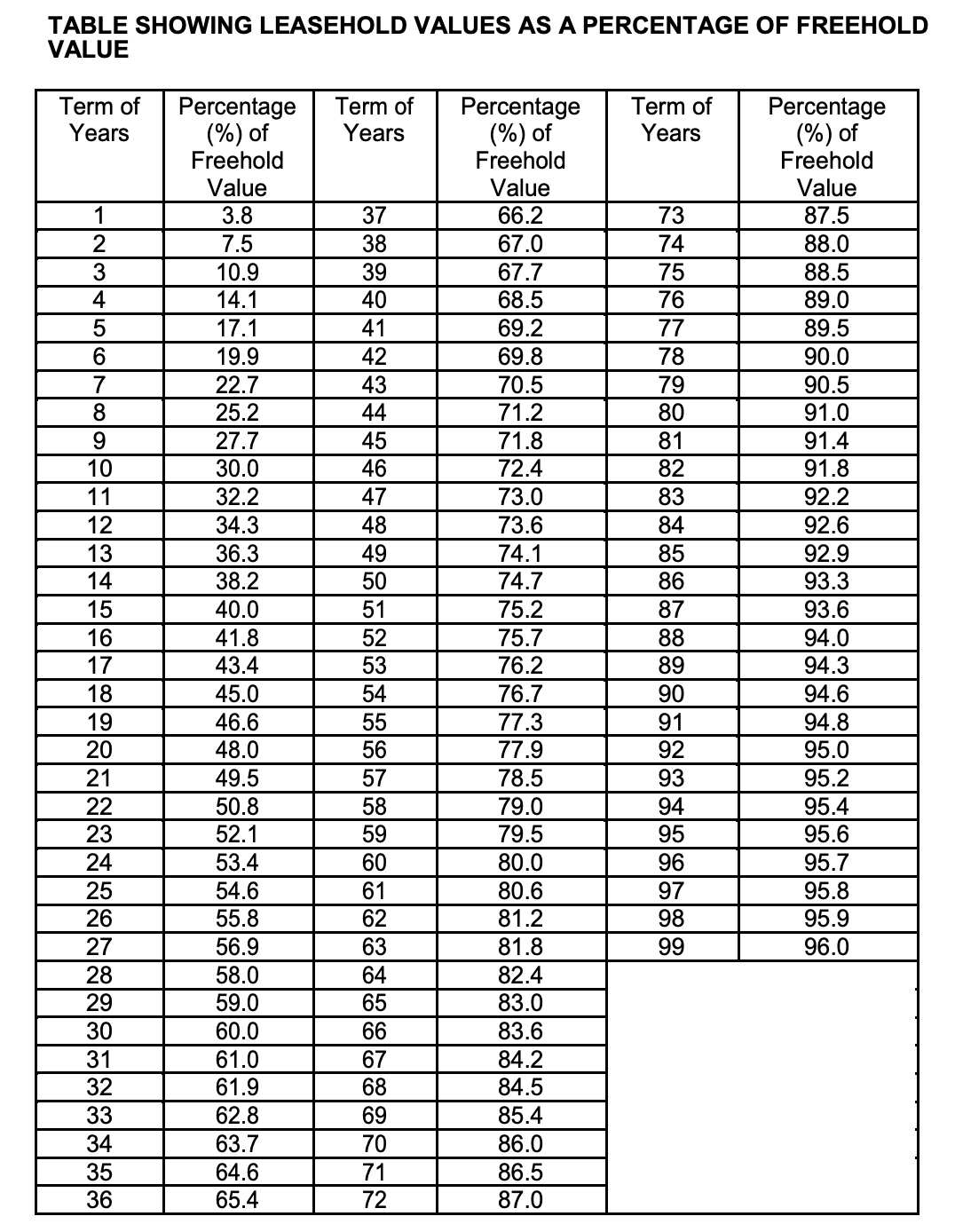
Source: Singapore Land Authority (SLA)
Historical resale metrics reveal that older freehold properties protect wealth far better:
The Price Gap: The average resale price of freehold condos older than 40 years old stood at $1,730psf, significantly higher than the $1,173psf recorded for comparable 99-year leasehold peers.
Recent Velocity: From 2020 to 2025, older freehold resale units grew by 32.2%, outstripping the 26.9% growth rate seen in matching vintage leaseholds, widening the net pricing gap from $320psf back in 2015 to $557psf.
Freehold units remain fundamentally immune to lease decay, ensuring strong resale price retention and keeping the door open for collective sale (en-bloc) potential down the road.
For pure property investors, rental income is an essential component of total returns. Tenure has virtually no impact on what a tenant is willing to pay monthly; tenants judge a property strictly by its location, proximity to transport nodes, condition and lifestyle amenities.
Because a freehold condo typically commands a premium entry cost compared to a leasehold property of the exact same size in the same neighborhood, the rental yield equation favors leaseholds:
Fresh 99-year leasehold condos routinely display gross rental yields that are 30 to 50 basis points (0.3% to 0.5%) higher than comparable freehold options.
Lower purchase prices translate directly into superior cash-flow runways for landlords during the first half of the property's lifecycle.
99-Year Leasehold Condominium
Entry price: Lower capital outlay
Budget fit: Tighter capital budgets
10-year growth: Faster percentage appreciation
Recent trend: Strong short-term growth
Long-term resale: Susceptible to lease decay
Buyer restrictions: Tightened CPF usage rules
Financing constraints: Restricted bank loans later
Rental yield: Higher average yields
Yield driver: Lower capital denominator
Legacy value: Diminishes over time
En-bloc potential: Requires lease top-up costs
Freehold Condominium
Entry price: Premium initial cost
Historical gap: 10%–20% higher market premium
10-year growth: Steady and stable growth
Market volatility: Resilient during economic downturns
Long-term resale: Holds value robustly
Aging dynamics: Pricing gap widens over time
Rental yield: Historically lower yields
Rental reality: Premium costs unpassed to tenants
Legacy value: Perfect generational wealth transfer
En-bloc potential: Higher pricing leverage
The decision between freehold and leasehold is not a matter of which tenure is universally superior, but which one aligns with your financial timeline.
Choose Leasehold if: You are a first-time buyer with a constrained budget, you intend to exit the property within 5 to 10 years to upgrade, or your goal is to maximize short-term rental yields.
Choose Freehold if: You are looking for a defensive asset to preserve capital through market cycles, you plan to live in the home for decades, or your primary objective is to leave a tangible property legacy for your children without the looming threat of lease expiration.
Ultimately, savvy property buyers must look beyond tenure alone. A condo's proximity to future infrastructure developments, URA master plans, layout efficiency and localized demand depth remain the absolute pillars of long-term real estate profitability in Singapore.

Aaron Kong is a highly dedicated real estate professional specializing in the buy, sell and renting of properties. Spanning both the residential and commercial sectors, Aaron serves a diverse clientel...